
The Origin Story
Six Weeks Old and Already Running Group Therapy
One of the first things I noticed about the chicks was how tightly they were wired to each other.
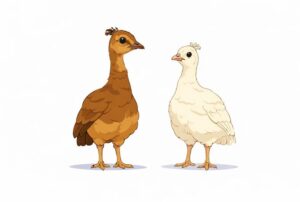
By six weeks old, they still looked like toddlers. All fluff and ambition. Scrawny, half-feathered baby birds whose wings were getting heavy with new growth. They’d flap, lose steam, and have to lie down and rest like they’d just run a marathon they did not train for.
If one wandered out of sight, the other panicked.
A sharp, high-pitched whistle cut through the brooder. Frantic. Searching.
If the missing chick heard it, it answered immediately. Same pitch. Same urgency.
It was like Marco Polo.
With consequences.
What surprised me was that the same chicks who could not tolerate being separated for thirty seconds also could not tolerate touching.
They pecked at each other’s faces constantly. Not playfully. Not gently. Pure toddler logic.
Stop touching me.
You ‘re touching me.
Stop touching me.
They went at each other hard enough that I started worrying someone was going to lose an eye.
I finally added mirrors to the brooder after reading they could create a “virtual flock.”
It worked instantly.
The two chicks calmed down, sat side by side, and stared at themselves for hours.
Peace, restored through vanity.
Everyone Else Had a Crowd
Han Solo and Leia, meanwhile, had a very different start.
They were raised by the breeder in a barn, almost certainly in a large pen with other chicks. Then there were seven of them total, all boxed together when Marley and I picked them up. She took four. I took three.
They had never been alone.
Until suddenly, they were.
When it came down to just the two of them, it hit me that they’d gone from a crowded barn, to a group of seven, to each other. No buffer. No extras.
That’s when I started worrying.
Not about stress.
Not about loneliness.
About what would happen if one died.
From everything I’d read, a lone peacock is a problem waiting to happen. They can become aggressive. Territorial. Mean in a way that doesn’t unwind later.
If I ended up with one chick, I wouldn’t just have lost the other.
I’d have created a future issue.
And when I start worrying, I start making plans.
None of the Options Were Comforting
I had options. None of them were great.
I was not going back to that breeder. Losing a chick had taken more out of me than I expected.
I also wasn’t in any shape to travel and pick more up.
That left two paths.
I could order chicks through the mail and hope I didn’t open a box to a disaster.
Or I could order eggs and hatch them myself.
Shipped chicks come with their own risks. You open the box, and then you find out whether the universe is feeling generous that day.
Eggs, at least, fail quietly.
A breeder I trusted told me to expect about a 30% success rate getting peachicks hatched and raised to four months.
Those were not odds I loved.
But I loved them more than opening a box and finding a tragedy.
Math, But Make It Emotional
So I chose the harder option.
I ordered eggs.
Then I had to decide how many.
If things went too well, I’d end up with half a dozen chicks and a husband who was going to shoot me.
If things went poorly, I’d be right back where I started. One chick. Same problem. Different spreadsheet.
So I did the math.
Thirty percent of seven is 2.3 peacocks.
Which felt… responsible.
I ordered seven eggs on eBay and waited for the mail.
If you need me, I’ll be staring at tracking numbers and googling “how to tell your husband you might have seven new chicks.”
Subscribe to get posts as they are released!