The Part Where the Ranch Finally Looked Like the Plan
The Part Where the Ranch Finally Looked Like the Plan
The pen became unnecessary gradually, and then all at once.
For the first eight weeks in the greenhouse, I ran supervised walkabouts. Out to the pen in the morning for the younger ones, Han and Leia were back in before dusk. Controlled range. Predictable return. The kind of routine that sounds simple and requires constant management.
The birds were not nervous about this. They took to the property like they had read the survey and had opinions about the acreage.
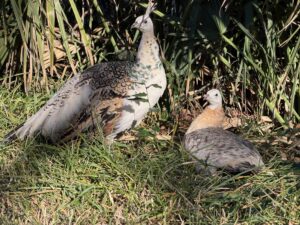
Han Solo appointed himself perimeter patrol immediately. Leia appointed herself supervisor of Han’s patrol.
By week four, they were moving like they’d always lived here. They were old pros who had simply been waiting on the paperwork.
The Part Where the Pen Became Unnecessary
Morpheus made the case first.
She had always treated containment as a puzzle rather than a boundary, and the pen divider was no exception. One morning I went out to find her on the wrong side of it, Neo still on the correct side, both of them looking at me with entirely different energies.
Morpheus: calm, expectant, ready for the day.
Neo: present, waiting, committed to whatever happened next.
I took the divider down.
For a while after that, the two pairs maintained their own territories out of habit — Han and Leia on one end, Morpheus and Neo on the other. The pecking order doesn’t end when the netting comes down. It just gets bigger. More square footage, same social architecture.
But they were sharing space. Moving around each other. Coexisting on a ranch-sized scale instead of a pen-sized one.
This was the plan.
What This Was Always Going To Be
Eight months before this, I had sat across from my husband and laid out a 37-point case for why peacocks were a reasonable life choice.
The pitch included: they roost in trees, they free range, they don’t need a coop, they’ll find a lot of their own food, and I will handle all of it.
The promise to James wasn’t fully delivered yet — there was still the greenhouse, still daily care, still a lot of moving parts that hadn’t simplified. But the work was all mine. He hadn’t been dragged into any of it.
I could see the shape of that promise starting to form.
Four peafowl, loose on the property, doing what peafowl do. Patrolling. Foraging. Making noise about things that may or may not warrant noise.
There is no last plan. There is only the next one.
Spoiler: it was not even close to the last one.
This is how it started. A loophole, a pitch meeting, a box of peachicks, and a ranch that earned its name in the first week.
If you need me, I’ll be watching four birds pretend they’ve always lived here, updating my blog and googling “at what point does chaos become normal and is there a support group.”
The Great Relocation
The Great Relocation (Or: How I Got My Porch Back)
Morpheus and Neo were ready to move out.
I knew it. They knew it. My porch knew it.
Han and Leia had been in the not-a-coop greenhouse for about a month. In that time, the little ones had been doing what Morpheus and Neo do best: wandering, growing, developing opinions, and generally maturing at a pace that suggested they had somewhere to be.
It was time.
The problem was that nobody had told Han and Leia.
Peachick Daycare (Also Known as Pecking Order 101)
For weeks before the move, I’d been running a daily social experiment that was going exactly as well as you’d expect.
Every morning, I took Morpheus and Neo outside to a segregated section of the pen for what I had generously started calling Peachick Daycare. Separated by netting. Perfectly safe. Just getting everyone used to the idea of each other.
There is a reason they call it a pecking order.
It is not a metaphor. It is not a polite suggestion. It is a very literal system in which the older birds remind the younger birds, repeatedly and without apology, exactly where they stand in the hierarchy. The younger birds learn this by trying. And trying. And trying again. Until they understand that deference is not optional, and the older birds’ personal space is not a suggestion.
Morpheus and Neo tried.
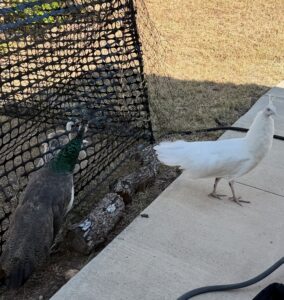
Han and Leia treated every session like a border incursion that needed to be repelled immediately. The moment the little ones appeared, the older birds postured, rushed the netting, and made it abundantly clear that these smaller birds were not welcome, had never been welcome, and should consider other living arrangements.
Indefinitely.
The chicks kept trying. The older birds kept correcting them. This is, technically, how it is supposed to work. The younger birds eventually learn to read the room — to respect the bubble, defer to their elders, and stop poking the situation with a stick.
It just takes a while.
And until it clicks, someone is always getting pecked.
It became clear that if I waited for harmony to arrive on its own schedule, I would be waiting until Morpheus and Neo were old enough to retire.
The Plan (Such As It Was)
I needed a solution that didn’t require anyone’s cooperation.
The greenhouse had to be divided. One side for the little ones, with access to the pen. One side for Han and Leia — except Han and Leia weren’t going to be in it anymore.
That was the other part of the plan.
It was time for Han and Leia to be spending their days semi-free ranging anyway.
So the plan was: give half the greenhouse to Morpheus and Neo. Let Han and Leia spend their days outside the pen, roosting back in the greenhouse at night. Everyone gets more space. Nobody has to agree to anything.
I was determined not to feel guilty about it.
I needed my porch back.
The Move
Morpheus and Neo moved into their new quarters with the energy of soldiers who had won this war — never mind the details of how many times they’d been pecked getting here — and were not going to waste a single square foot of hard-earned territory.
They had a lovely pen. They had space. They had each other.
New space. New routine. Older birds visible but unreachable. And mom?
Mom was not on the porch anymore.
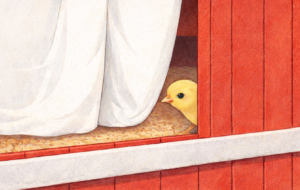
For five months, I had been right there. A door away. Close enough that Morpheus could push a curtain aside and confirm I still existed. The porch had been home base — hers, mine, ours by default.
Now I was inside.
And she was outside.
And the greenhouse was not the porch.
She had thoughts.
It wasn’t the smoothest transition. Morpheus made sure I knew, in the way Morpheus always makes sure I know things: repeatedly, at volume, until the message had been received and confirmed.
I kept my distance. Held the boundary. Reminded myself that this was right and necessary and good for both of us.
Probably.
The Part Nobody Expected
Here is the thing I did not anticipate.
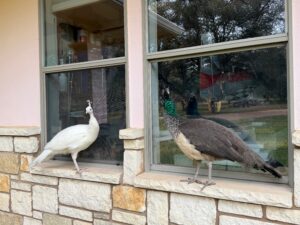
The cats noticed.
For five months, Ted and Bill had lived alongside the porch brooder situation with the tolerance of two animals who did not consent to any of this but had decided to make it work. They watched. They observed. They maintained the dignified distance of creatures who had opinions but chose not to voice them.
Bill, especially, had developed a habit of sitting at the back door.
Just watching.
Every day. The birds going about their business. The chaos of the brooder. The sound and the motion and the whole ridiculous operation happening six feet away through the glass.
After the move, I caught him at the back door again.
Same spot.
Just — not watching anything.
The porch was quiet. The brooder was gone. Five months of feathered entertainment, abruptly cancelled.
I had not expected the cats to miss them.
The First Night
That evening, I watched the little ones figure out what to do with themselves at dusk.
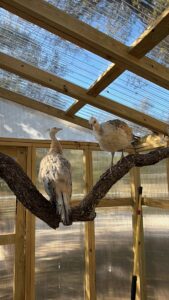
On the other side of the netting, Han and Leia settled onto their perches — the ones they’d been using for a month, the ones that were theirs, the routine they’d established without any input from me.
Morpheus and Neo watched them.
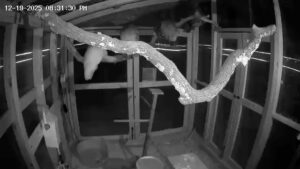
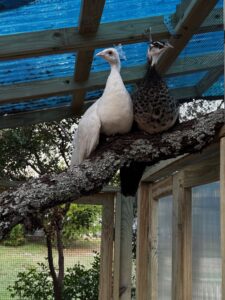
Then they flew up to the branch I’d installed on their side.
First try.
They just looked at what the older birds were doing.
And they did it.
I stood there for a moment, watching four peacocks arranged on either side of a piece of netting, each pair on their own perch, settling in for the night.
If you need me, I’ll be on my porch enjoying the quiet and googling “how long before peacocks find a new way to complicate things.”
The Accidental Walkabout
The Accidental Walkabout
Han and Leia moved into the greenhouse.
This sounds simple. It was not entirely simple. Within the first few days I discovered they’d been flying up to roost in the upper windows every night, which meant they needed an actual branch to grip. The branch I cut came in at sixty pounds and took two people to install. Han and Leia used it on their schedule, appreciated it on their schedule, and have never once acknowledged the effort.
But they were out of the rabbit hutch, which meant Morpheus and Neo could finally move up.
What I Noticed
Morpheus and Neo graduated to the rabbit hutch.
They were thrilled. You could tell. They ran the length of it immediately — back and forth, back and forth — confirming the square footage like birds who had been promised this and were now verifying the terms.
The porch, for the first time in months, had breathing room.
Sort of.
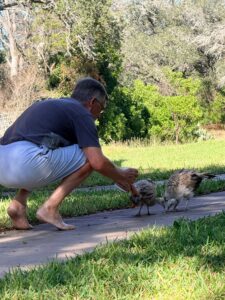
When I let them out on the porch floor, they followed me.
Not in a vague, loosely-in-the-same-direction way.
Right behind me. Both of them. Wherever I went, they went. If I stopped, they stopped. If I turned around, two small birds were looking up at me waiting for the next development.
They were underfoot constantly. On my feet, behind my feet, in the way of my feet. The porch that had just gotten its breathing room back was already a minefield of small birds who had decided I was the most interesting thing in it.
Which is how I found out they would follow me anywhere.
The Cat Carrier
My first idea was a proper field trip.
I had an enclosed garden area outside — big enough to explore, secure enough that nobody was getting lost. Good bugs. Real dirt. I got out the cat carrier.
Morpheus and Neo had opinions about the cat carrier.
These opinions were unanimous and loud.
I managed to get them in. I managed to get them to the garden. I got them out. They ran every inch of that space with the energy of birds who had been waiting their whole short lives for exactly this.
Then I had to get them back in the carrier.
I managed it once.
Once.
The carrier was retired. We do not talk about it.
Which left an obvious question.
How to get them outside
I opened the porch door, stepped outside, and looked back.
Morpheus and Neo looked at the door. Looked at me.
And walked out.
We started small — two weeks on the driveway, short loops, nothing ambitious. They stayed right behind me, investigating gravel, pecking at things that probably weren’t food, conducting whatever quality-control process a peachick runs on a gravel driveway.
Then I started wondering how far they’d actually go.
300 Yards
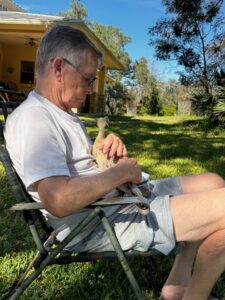
My parents live next door. About 300 yards of open ground between us.
I turned and started walking.
Morpheus and Neo followed.
Not just to the edge of the yard. Not just partway. The whole distance, through the grass, single file.
My parents were sitting outside in lawn chairs. The birds walked right up, looked around, and immediately found the dense scrub-grass area at the edge of the yard that apparently ticked every box a peachick has for an ideal afternoon.
They burrowed into it. Sat down. Looked extremely satisfied.
When my parents held out treats, both birds came right over and jumped up to investigate — checking pockets, checking hands, checking whether any of this was edible.
It was, by every measure, a success.
The Weekly Ritual
This became a thing.
Every week, same route, same visit. My parents waiting in the lawn chairs, the birds heading straight for the scrub grass and then circling back for treats. Neo and Morpheus getting comfortable with different ground, different trees, different sounds.
When it was time to go, I’d turn around and start walking back.
They followed.
Every time.
All the way home. Up into the porch. Down for dinner. Done.
I want to be clear that none of this was a training program. The walkabouts were the accidental result of a cat carrier that only worked once and two birds who’d decided I was worth following.
But every time I tried to let them spend time near Han and Leia, I got the same answer. The older birds made it clear immediately and without subtlety that “nearby” was not an option they were offering.
So the walkabouts were what we had instead.
And they were, against all odds, exactly enough.
If you need me, I’ll be wherever they’ve decided we’re going today, googling “at what point does the human realize she was the one being trained.”
The Structure That Was Definitely Not a Coop
The Structure That Was Definitely Not a Coop
Here’s the thing about peachicks: they grow.
I know that sounds obvious. All baby animals grow. But peachicks grow in a way that suggests they are personally offended by the size of their enclosure and are determined to make it feel inadequate as fast as possible.
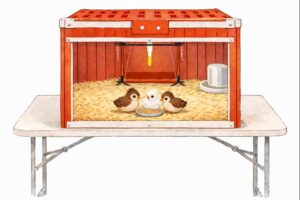
Han and Leia had started in the red brooder on the porch. Cozy. Manageable. A sensible amount of bird in a sensible amount of space.
Then they got bigger.
Then they got bigger fast.
By the time I was incubating the eggs that would become Morpheus and Neo, I’d already had to build the older two a rabbit hutch — eight feet long with a four-foot run attached — just to give them room to stretch, flap, and pace without turning the brooder into a demolition derby.
The upgrade worked. For a while.
But now I had four chicks on the porch, two age groups, and Han and Leia were putting on size like they’d made it a personal goal. The rabbit hutch that had felt generous two weeks ago was starting to feel like a studio apartment for birds who had discovered they had opinions about square footage.
Meanwhile, Morpheus and Neo were outgrowing the red brooder at a pace that suggested they had read ahead in the manual and were skipping chapters.
It was becoming very clear, very quickly, that the next step needed to happen soon.
Probably yesterday.
The Housing Crisis (A Progression Nobody Planned)
I had not set out to build three enclosures.
The red brooder was supposed to be it. One brooder. Simple.
Then Han and Leia needed more room, so I built the rabbit hutch.
Then Morpheus and Neo hatched and inherited the red brooder, which meant I now had two enclosures on a porch that was never designed to be an aviary.
Now the older birds needed to move outside. They needed real quarters — space to grow for the next six to nine months while they matured. Something with room. Something secure. Something that could handle birds who were getting big enough that the rabbit hutch was starting to look like a suggestion rather than a boundary.
Every enclosure I’d built had been a response to the same realization: birds grow faster than plans.
I was chasing a moving target with lumber and screen.
The whole peacock pitch — the 37-point plan, the careful presentation, the “this is your one chance” moment — had been built on a foundation of “they roost in trees” and “they free range” and “you will not have to clean anything.”
A coop would have been an admission that this was, in fact, poultry ownership with infrastructure.
A coop would have meant James was right.
A coop was not an option.
So I started looking up plans online. Walk-in coops. Predator-proof enclosures. Large bird shelters.
And that’s when I noticed something interesting.
Every single “walk-in coop” plan I found was essentially a greenhouse with screen on it.
A greenhouse.
I love to garden. I had been wanting a greenhouse for years. And here, staring back at me from the internet, was a structure that was clearly, obviously, and undeniably a greenhouse.
It could just also house birds with some modifications.
The logic was airtight.
The Pitch (Such As It Was)
I proposed it to James as: “Hey, can I build a greenhouse that can temporarily be used for the birds?”
I didn’t get an objection.
I took that as permission and moved on.
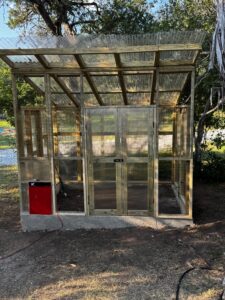
I designed it myself.
Side entry doors. Wide front doors. Tall enough to walk in comfortably. Wide enough on the sides to eventually store the family mower.
It was a gardening structure. It would house the birds for the interim — six to nine months, maybe a year — and then transition into a proper greenhouse for me.
A greenhouse that could have tree-limb perches.
And heaters.
And eventually, cameras.
Details.
I hired two of the guys who had worked on previous outside projects with me, and construction began. We built it with a twenty-five-by-fifteen-foot pen attached, giving Han and Leia the kind of square footage that peafowl actually need.
Definitely a Greenhouse
The structure went up quickly.
It had screen walls. A solid roof. Doors that latched. A pen where the birds could spend their days with room to run, flap, and do whatever teenage peafowl do when they think no one is watching.
It was everything Han and Leia needed for the next chapter.
And it was absolutely, unequivocally, without question, a greenhouse.
If it looked like a coop, functioned like a coop, and housed birds like a coop — well, that was just a coincidence that nobody in this household needed to discuss.
If you need me, I’ll be adjusting the perches in my “greenhouse” and googling “at what point does a gardening structure become a coop and is there a legal precedent.”
The Morning Morpheus Scalped His Brother
The Morning Morpheus Scalped His Brother
One of the things nobody prepares you for with peachicks is the picking.
They pick at everything.
Not casually. Not occasionally. Obsessively. If something exists and it is slightly different from the thing next to it, a peachick will find it, examine it, and attempt to remove it from the surface of the earth.
A loose thread on your shirt. A seam on a shoe. A freckle on your hand.
Morpheus was especially gifted in this department. He would zero in on a freckle on my hand — a personal offense, clearly. Not a peck. A project. A deliberate, focused attempt to correct what he felt was a manufacturing defect in my skin.
I’d learned early on with Han and Leia that this habit doesn’t stop at inanimate objects. They’d pecked at each other’s faces so relentlessly that I’d added mirrors to the brooder — instant virtual flock, instant calm. Han was especially committed. He’d park himself in front of the mirror for hours — finally, someone who understood him.
But mirrors only solve the boredom problem. They don’t solve the “something new just appeared on my sibling and I need to investigate it immediately” problem.
The Crime Scene
One morning, I checked on the little ones and found Neo looking as though he’d lost a fight he didn’t know he was in.
The tiny crest feathers that had just started to emerge — barely there, brand new, the first sign of the bird he was becoming — were gone.
Just gone.
In their place: a small bloody spot on the top of his head.
And another one on his neck.
I stared at him.
I stared at Morpheus.
Morpheus stared back with the vacant, cheerful expression of someone who had absolutely no memory of committing a crime.
He had scalped his own brother.
Not out of malice. Not out of aggression. Out of pure, unrelenting curiosity. New feathers had emerged. They were different. They were there. And Morpheus could not leave them alone until they weren’t.
The Day I Turned My Bird Purple
I scooped up Neo and brought him inside.
He was fine. Annoyed, maybe. But fine. The spots were small, and he was more confused about the sudden change of scenery than bothered by the tiny wounds.
In my first aid kit — the one I’d been assembling since the morning I lost Luke — I had Blue-Kote. It’s a gentian violet antiseptic with a dauber applicator, designed for exactly this kind of thing. You dab it on. It disinfects. It discourages further picking because the taste is terrible.
It also turns everything it touches a vivid, unapologetic purple.
I dabbed Neo’s head. I dabbed his neck.
And then I stood back and looked at what I’d done.
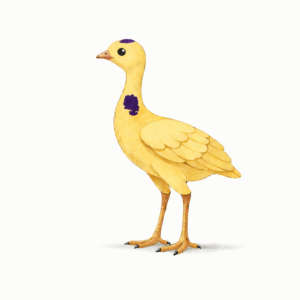
My tiny yellow chick now had two enormous purple splotches — head and neck — as if a very small graffiti artist had tagged him while I wasn’t looking.
This was not the look I was going for.
And now I had a new problem: I was about to put this freshly purple bird back in with Morpheus, the chick who could not resist anything that looked different.
Two giant purple spots on an otherwise yellow bird?
That was a neon sign that read: PICK HERE.
I held my breath and put him back.
Morpheus looked up.
Looked at Neo.
Looked at the purple spots.
And went back to doing whatever he’d been doing before.
Nothing.
Zero interest.
It turned out Morpheus had taken a nap while Neo was being treated. And whatever had happened before the nap had been wiped clean.
This wasn’t object permanence issues. This was ADHD in a three-ounce package. If you could distract him long enough — or in this case, wait for the system to reboot on its own — the obsession reset.
Sounded a lot like me, honestly.
From that point on, this became my primary Morpheus management strategy. You didn’t need to outthink him. You just needed to outwait him. If you could survive the current fixation, a nap or a meal or a sufficiently interesting bug would eventually clear the queue.
It wasn’t elegant. But it worked.
The Porch Show (Now With a Live Studio Audience)
So our days settled into a rhythm.
All four birds on the porch. The Morpheus Hour every night at sunset. Andrea Bocelli drifting through the screens while Morpheus performed his nightly duet with a man who did not know he had a co-star.
And every single day, Bill and Ted claimed their front-row seats.
Our two cats had been using that screened-in porch for nine years. It was their domain. Their kingdom. Their personal sunbeam collection agency.
Then I turned it into a chick nursery.
They could have been resentful. They could have staged a protest.
Instead, they discovered they had been given the greatest gift a house cat can receive: live television.
Every morning, Bill and Ted stationed themselves in the chairs by the glass porch doors and watched.
All day.
Sunrise to sunset.
Not the way cats watch birds outside — that focused, twitchy, predatory tracking. This was different. Two retirees who had found a channel they didn’t know existed and could not stop watching.
The cats watched them eat. Watched them flap. Watched them chase each other in circles for no reason. Watched Morpheus have opinions. Watched Neo follow those opinions to their logical and usually chaotic conclusion.
Every night when the Morpheus Hour kicked off and the whistling started, Bill and Ted conveniently found somewhere else to be.
They had lost their porch. But they’d gained sunup-to-sundown entertainment.
Fair trade, apparently.
If you need me, I’ll be dabbing purple antiseptic on a bird and googling “is it normal for a peachick to forget a crime during a nap or should I be concerned.”
Morpheus and the Nightly Aria
Morpheus and the Nightly Aria
Morpheus quickly got nicknamed “my problem chick.”
Imprinting was no joke.
At a week old, we moved the little ones out to the porch brooder. During the day, I could cover the brooder window, and Morph would forget about me for longer stretches.
Out of sight, out of mind.
Until he figured out he could push the curtain aside and check.
After that, every time I opened the porch door — feeding, checking, just passing through — it was over. Full alarm. The Morpheus Whistle.
If you’ve never heard a distressed peachick calling for its person, imagine a smoke detector that developed feelings of abandonment.
I was the British nanny of chick-rearing. Loving. Structured. Firm boundaries. I told myself this was working. I told myself the separation was good for both of us.
It was going great.
But every single night at 8pm, as the sun set, the whistle began. Not “Mama.” But ” MAMA! MAMA!!” On repeat.
Thirty minutes. Sometimes longer. Nightly. Reliably. Like a tiny feathered air raid siren who had opinions about bedtime.
I tried everything. Lights on late, then quickly dimming. Slowly dimming. Leaving them on. Turning them off.
He hated all of it equally.
Not that we knew Morpheus was a “he” or a “she” yet. But when you name a chick Morpheus, you commit to the pronoun for a while.
The Rest of the Flock Was Not Amused
As much as Morpheus had imprinted on me, I had imprinted right back.
There were days I thought it was harder on me than it was on him. Hearing him call and not going to him. Sitting inside, staring at the wall, reminding myself that boundaries were the right call.
Probably.
Meanwhile, the other three chicks were trying to process this nightly chaos.
Han and Leia — the two older ones — kept exchanging looks like they were trying to figure out why this sound should concern them. They’d startle, settle, startle again. Eventually they just tried to ignore it.
And Neo.
Neo, Morph’s actual sibling, had already developed a permanent expression I can only describe as:
How am I related to this guy.
I couldn’t blame any of them. Most nights, all three just tucked in and pretended the whistle wasn’t happening.
Same, honestly.
The Night James Made a Comment
One evening, James slipped in a casual:
“So… how long is this going to go on for…”
Fair question. One I had been actively avoiding asking myself.
I decided it was time to get drastic.
Music. I’d read somewhere that someone had used it to calm stressed chicks. I grabbed a speaker, pulled up my phone, and started auditioning genres for the world’s most demanding audience of one.
Country. Tim McGraw. We live in Texas. I was sure this was it.
Nothing.
Willie Nelson. We are literally a few miles from his ranch.
Nothing.
Jim Brickman. Piano. Nothing on earth can resist Jim Brickman.
Morpheus could resist Jim Brickman.
John Denver. Maybe he needed old-school. It would drive James nuts, but anything was better than the whistle.
Nada.
Classical instrumentals.
But — wait. Longer pauses between whistles.
He’d slowed down with classical. What if I added voices.
Noted.
The Last Option I Could Think Of
I went nuclear.
The Three Tenors. Pavarotti. Plácido Domingo. José Carreras.
Full opera.
My thinking was that if nothing else, maybe Luciano Pavarotti could drown out a peachick.
He stopped.
Not immediately. But five to ten minutes instead of the thirty we’d all been suffering through.
The Three Tenors had done what Tim McGraw, Willie Nelson, Jim Brickman, John Denver, and the entire classical canon could not.
Over the next few days, I narrowed it down further.
Morph didn’t just like opera. He had preferences.
Andrea Bocelli’s Sacred Arias album. And not even the whole album — specific tracks.
So every night at dusk, anyone within earshot — neighbors, boats passing by on the lake — got the nightly show.
Andrea Bocelli at full volume, singing “Ave Maria” and “Panis Angelicus.”
Morpheus at fuller volume, whistling over him like a tiny, tone-deaf diva who had generously allowed Bocelli to open for her.
The Part Where This Became My Life
There is no scientific explanation for why opera works on a peachick.
I read that it worked for birds. I stopped questioning why. You just accept it and hope no one asks follow-up questions.
Every night for three months, I queued up Sacred Arias at sunset like it was a religious obligation. The whistle dropped from thirty minutes to ten. Sometimes five.
He never skipped it.
Neither did I.
Because if I forgot, he reminded me.
It became known as “The Morpheus Hour.”
I had not trained a chick to sleep.
I had trained myself to perform a nightly concert for a bird.
So much for boundaries.
If you need me, I’ll be trying to figure out how to file a complaint with Spotify after three months of my algorithm being permanently hijacked by a peachick.
At this point, you have to fill in for mama. That means teaching them to eat and drink.
Peachicks are notorious for not knowing instinctively how — or what — to eat. I added some water to the chick starter to make it mush, put a drop of water on my finger, and prayed.
If I could get one to do it, the other would follow.
At first, they weren’t interested.
Then one took the drop of water on a closed beak.
It dribbles into the crack.
Swallow.
Pay dirt.
I tapped the mash.
No dice.
They can go 48 hours without food after hatching. I was on hour four.
Plenty of time to panic later.
The One Who Always Came to My Voice
They were darling, though.
They would run in and out from under the brooder plate — a warming device I had surrounded with feathers to simulate “mom.”
Mom was a heat lamp and some craft supplies.
One of them always came out to my voice.
That was Chick 2.
Almost identical to Chick 1, except for demeanor. I could always tell them apart instantly. Chick 1 was cautious. Chick 2 had opinions.
I tried so hard to leave them alone. I did not want them to imprint on me.
I had read horror stories of “bathtub chicks.”
These are the birds raised by well-meaning novices who do no research. They start the chicks in a bathtub instead of a proper brooder. They let them follow them around the house — where they can get stepped on, lost, or worse. They cuddle them constantly. They set no boundaries.
Then, months later, they put this fully bonded bird outside in a pen.
And they wonder why it screams.
And bites.
And holds a grudge for the next thirty years.
A bathtub chick doesn’t just cry for attention. It grows into a large bird with resentment issues and a long memory.
There was no way that was going to fly here.
I was adorable.
The Day the Battle Began
The day after they hatched, Chick 2 started to whistle when I left the room.
Oh no.
I tried to distance myself. Dimming the room for nap time seemed to work.
Then, in the middle of a teleconference, Chick 2 started to whistle.
Loudly.
Not a tiny chick whistle.
A “you can hear it in the other room” whistle.
A “your clients are now aware you have livestock” whistle.
Three ounces of bird. All of it lungs.
And it didn’t stop.
I ignored it as long as I could. Then I finally said, “Hold on,” walked with my laptop into the guest room, and sat on the floor.
The chick saw me.
Silence.
Immediate silence.
Like a toddler who was fully prepared to scream until someone showed up, and now that someone had shown up, everything was fine and always had been.
I showed my teleconference attendee my “predicament” — which got the expected ohs and ahhs.
And I sat on that floor for the next hour.
Because apparently I work for a bird now.
At the time, I didn’t know if I was winning or losing. I didn’t know if this chick was a boy or a girl — and males have it worse with imprinting. I didn’t know if the boundaries I was trying to set would hold.
All I knew was that this was going to be an uphill battle.
Spoiler: it was.
The Realization
I noticed this little one didn’t have object permanence yet after waking up. If I wasn’t visible, I didn’t exist. And if I didn’t exist, that was cause for alarm.
So I dashed out and decided they needed more space. Distance. Boundaries.
You know. The things that work on birds.
That little chick — who was later named Morpheus because of its lung capacity — kept this up every time it saw me, right up until it fell asleep.
At one week, I moved them out to the porch.
From then on, I was summoned every day.
Maybe once.
Maybe.
For months, it was an uphill climb. Boundaries tested. Whistles ignored. Guilt suppressed.
But that’s a story for later.
If you need me, I’ll be realizing there is no spoon, there is no schedule, there is only Morpheus and googling “how to explain to a bird that I have other responsibilities.”
The Month I Decided to Hatch My Own Problems
The end of June marked the beginning of one of the longest months I’ve had in years.
I was two weeks into owning peachicks. I had lost one to circumstances beyond my control. And I had doubled down.
No.
Tripled down.
I had decided to hatch seven eggs myself while still recovering from six broken ribs, fully aware that my expected losses were somewhere around 70%.
This might be the part where my family started wondering about my sanity.
The Part Where I Waited For The Mail
I spent my days recuperating from the accident while happily mother-henning two small chicks. Han and Leia were thriving. I was vertical. Progress.
The eggs arrived a week later.
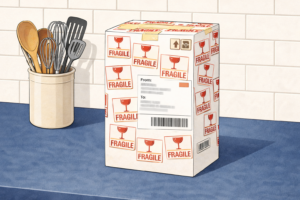
They had endured way too long in the hands of the US Postal Service. One of the things you’re supposed to be careful about when shipping eggs is transit time — especially if you have warm days or postal holidays.
I had both.
The seven eggs arrived just before the weekend. Had they gone one more day, I might not have had any viable eggs at all.
Into the incubator they went.
And because I am who I am, I started a spreadsheet to track their weight.
Of course I did.
Every week when I candled, I weighed each egg in grams and logged it. The humidity in the incubator got adjusted accordingly. If I was going to do this, I was going to do it right.
The Rings of Death
At one week, I candled them.
For those unfamiliar, candling is when you shine a light through the egg to see what’s happening inside. You’re looking for veins, movement, signs of life.
You’re also looking for rings of death.
That’s not me being dramatic. That’s the actual term. A dark ring inside the egg means the embryo stopped developing. Game over.
I spotted three.
By day fourteen, we lost another.
All four were discarded.
Seven eggs became three.
Here’s the thing I didn’t expect: part of me was relieved.
The math was working. The odds I’d been warned about were holding. And somewhere around day fourteen, reality started kicking in.
I had made this decision on heavy painkillers. I had ordered seven eggs while recovering from six broken ribs, running on optimism and whatever was left of my critical thinking skills.
What if the odds had been wrong?
What if I was staring down nine peacocks instead of the four I eventually ended up with?
James would have buried me in the backyard.
Three viable eggs felt… manageable. Three felt like the universe giving me an out I didn’t know I needed.
The Quiet Weeks
The next two weeks were easier.
The surviving embryos grew. They started twitching. Right before “lockdown” — the final days before hatch when you stop turning the eggs — all three were active.
One chirped at me through the shell that night.
Another kicked me through the egg wall. Literally. I touched the shell and got a tiny foot to the finger.
Our third egg — the largest of them all — was quiet. Not a lot of movement. Not a lot of airspace.
I told myself it was fine.
Lockdown
On the second day of lockdown, at 2 p.m., Chick 1 practically bounded out of the egg.
There was no slow unfolding. No delicate emergence. Just bam — wet, exhausted, and immediately making noise.
Chick 2 followed an hour later. Calmer. Quieter.
They were just Chick 1 and Chick 2 at this point. No names yet. Just two tiny aliens drying off under the heat lamp.
Then Chick 1 jumped the tall divider to get to Chick 2.
They huddled together like they’d known each other forever.
The One That Didn’t Make It
While they dried off and fluffed up, we waited for Egg 3.
The largest egg. The quietest egg.
It got the smallest of holes open.
Then stopped.
Nothing happened for an hour. Then two.
The books said leave it alone. The forums said the same. Some people do assisted hatches, but by the time I was ready to consider it, it was already too late.
Egg 3 never made it out.
The Math, Again
When the dust settled, we had two chicks.
Seven eggs. Three viable. Two hatched. One lost at the finish line.
25% survival rate.
Which meant we still had to make it through the next four months — the window where peafowl are most fragile — to call this anything close to a success.
They didn’t have names yet.
But they already had opinions about each other.
That much was clear.
Interestingly enough, Chick 1 and Chick 2 were Eggs 1 and 2 of the original seven. The largest. The healthiest. The ones that tracked ahead on every weigh-in from day one.
Science does science.
If you need me, I’ll be a little relieved the odds held and googling “how to retroactively thank your husband for not divorcing you when you explained the math on seven eggs.”
If you need me, I’ll be a little relieved the odds held and googling “how to retroactively thank your husband for not divorcing you when you explained the math on seven eggs.”
The Hatching of a New Plan
Six Weeks Old and Already Running Group Therapy
One of the first things I noticed about the chicks was how tightly they were wired to each other.
By six weeks old, they still looked like toddlers. All fluff and ambition. Scrawny, half-feathered baby birds whose wings were getting heavy with new growth. They’d flap, lose steam, and have to lie down and rest like they’d just run a marathon they did not train for.
If one wandered out of sight, the other panicked.
A sharp, high-pitched whistle cut through the brooder. Frantic. Searching.
If the missing chick heard it, it answered immediately. Same pitch. Same urgency.
It was like Marco Polo.
With consequences.
What surprised me was that the same chicks who could not tolerate being separated for thirty seconds also could not tolerate touching.
They pecked at each other’s faces constantly. Not playfully. Not gently. Pure toddler logic.
Stop touching me. You ‘re touching me. Stop touching me.
They went at each other hard enough that I started worrying someone was going to lose an eye.
I finally added mirrors to the brooder after reading they could create a “virtual flock.”
It worked instantly.
The two chicks calmed down, sat side by side, and stared at themselves for hours.
They were raised by the breeder in a barn, almost certainly in a large pen with other chicks. Then there were seven of them total, all boxed together when Marley and I picked them up. She took four. I took three.
They had never been alone.
Until suddenly, they were.
When it came down to just the two of them, it hit me that they’d gone from a crowded barn, to a group of seven, to each other. No buffer. No extras.
That’s when I started worrying.
Not about stress.
Not about loneliness.
About what would happen if one died.
From everything I’d read, a lone peacock is a problem waiting to happen. They can become aggressive. Territorial. Mean in a way that doesn’t unwind later.
If I ended up with one chick, I wouldn’t just have lost the other.
I’d have created a future issue.
And when I start worrying, I start making plans.
None of the Options Were Comforting
I had options. None of them were great.
I was not going back to that breeder. Losing a chick had taken more out of me than I expected.
I also wasn’t in any shape to travel and pick more up.
That left two paths.
I could order chicks through the mail and hope I didn’t open a box to a disaster.
Or I could order eggs and hatch them myself.
Shipped chicks come with their own risks. You open the box, and then you find out whether the universe is feeling generous that day.
Eggs, at least, fail quietly.
A breeder I trusted told me to expect about a 30% success rate getting peachicks hatched and raised to four months.
Those were not odds I loved.
But I loved them more than opening a box and finding a tragedy.
Math, But Make It Emotional
So I chose the harder option.
I ordered eggs.
Then I had to decide how many.
If things went too well, I’d end up with half a dozen chicks and a husband who was going to shoot me.
If things went poorly, I’d be right back where I started. One chick. Same problem. Different spreadsheet.
So I did the math.
Thirty percent of seven is 2.3 peacocks.
Which felt… responsible.
I ordered seven eggs on eBay and waited for the mail.
If you need me, I’ll be staring at tracking numbers and googling “how to tell your husband you might have seven new chicks.”
The Day I Learned There Are 101 Ways a Peafowl Can Die
No help. I grabbed a shovel and hoped I’d find a spot that wasn’t solid rock. This is not a small hope in Central Texas, especially when you have six broken ribs.
I got lucky. I managed a hole just big enough.
I moved a cinderblock on top of his tiny grave. It was painful in every sense. How could this have happened on my watch. I was damn sure I wasn’t going to let coyotes or raccoons disturb it.
I went back inside, sat down, and started rereading every source of information I could find on the various things that can go wrong with peacocks. I read into the night about peachick health issues until my eyes were bleary, as if the answer might be hiding in the margins this time.
That’s where the phrase started forming in my head:
There are 101 ways a peafowl can die.
Not dramatically.
Not metaphorically.
Just practically.
I couldn’t let another life slip through my fingers. I decided I was going to beat the statistics, or at least know when they were beating me. If something went wrong again, I wanted to recognize it while it was happening.
So I read everything.
Bacteria. Parasites. Viruses. Injuries. All the ways things can go wrong quietly and quickly. What became clear, fast, was that peafowl do not give you much of a window. They don’t linger. They don’t wait for plans. They have a habit of just… dying on you.
At an unreasonable hour, I ordered preventative medication for the other chicks. Waiting for shipping isn’t an option. You don’t get to pause a situation and say help is on the way. If something was going to happen, it was going to happen immediately, whether you were ready or not.
As soon as packages started arriving, I started assembling a first aid kit in a box in the corner. Not because I thought I could handle everything, but because I knew there wouldn’t be time to wait once something tipped.
My regular vet wasn’t helpful in that department. That’s not an indictment. It’s just how this works.
The Most Frustrating Part Was the Information
There is no definitive source for peacock care online.
What you get instead is a lot of people, all contradicting each other, all absolutely sure they’re right.
Welcome to the internet.
At some point, you have to pick a source and mostly stay with it.
That’s When the Phrase Really Stuck
There are 101 ways for a peacock to die.
You don’t panic about it.
You don’t dramatize it.
You just accept that this is part of the job now.
Be ready.
Pay attention.
Now play ball.
If you need me, I’ll be organizing a first aid kit again and googling “how many ways peafowl can die and why people keep raising them anyway.”
The Day I Started This with Six Broken Ribs
Twelve hours before the peachicks arrived, I was in the regional trauma hospital emergency room.
I had gotten into a wreck. Totaled my jeep. Broken six ribs.
The pain was bad enough that I passed out, which earned me an overnight stay.
My granddaughter was in the wreck with me.
She was okay.
Thankfully.
My whole family swarmed the hospital. They were worried about me. They were asking questions. They were doing the things families do in waiting rooms.
And all I could think about was that I was supposed to drive to get the chicks the next day.
I was a bit scrambled.
The Part Where I Was Supposed To Be Taking It Easy
I messaged Marley from the hospital bed.
She was also getting chicks. We had planned to pick them up together. I told her she would have to go without me.
She offered to hold onto mine as long as I needed to get back on my feet.
I was optimistically thinking days.
Maybe a week.
By the time I left the hospital, I had already rethought my whole approach. I switched to a full brooder setup on a table so I wouldn’t have to bend down. I adjusted everything I could adjust.
But there was one problem I couldn’t adjust away.
I had promised my husband I would not involve him.
This was exactly the scenario I needed not to happen. It was the one he predicted. The “what if you can’t take care of them” scenario. The one I had waved off with confidence and a 37-point plan.
I had promised, with every bone in my body — six of which were now broken — that I would handle this myself.
I was going to hold to that promise.
So three days later, I told Marley to bring them.
The Day They Arrived
I was set. Brooder together. Supplies ready. James had helped me move the heavy stuff.
So much for not involving him.
I just wasn’t lifting anything yet.
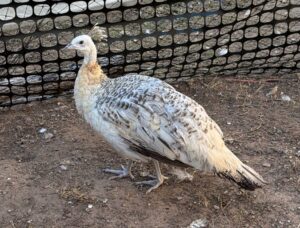
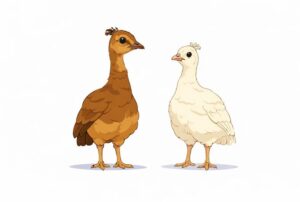
Three one-month-old chicks arrived. Two brown and one white.
They were groggy from the trip. A little out of it. But alive.
The white one seemed to boss the other two around, even half-asleep. After watching them settle in, I felt like they had Star Wars energy.
The white one, surely a girl, had to be Leia.
Which made the other two Han Solo and Luke.
The trio was introduced to their deluxe red brooder, and off we went.
The First Week
I survived the first week after the crash with new peachicks.
Somehow.
It was therapeutic, in a way. Staying moving. Staying motivated. These were living, breathing animals, and they were relying on me.
I couldn’t just lie in bed feeling sorry for myself.
Also, I really didn ‘t need to prove my husband right.
Marley had offered that if the chicks were ever too much, she would happily take them for her flock.
There were days I considered it.
But I kept going.
When Luke Started to Fade
Then Luke stopped thriving.
He became tired. Listless. He didn’t want to eat or drink. I couldn’t figure out what was wrong. I checked the forums. I consulted my books. I watched him constantly.
But there was no helping him.
He passed quickly.
I talked to Marley afterward. Two of her chicks had the exact same issue at the exact same time. They had taken way too long to recover from the travel.
She suspected they had been drugged.
A Hard Lesson
Tranquilizing birds for transport is nothing new.
In theory, it prevents travel shock. The downside is that if they can’t flush the tranquilizer out of their system, they won’t drink well — which is exactly what would help clear it faster.
A bad catch-22.
One-month-old chicks, traveling just an hour, should never have been given tranquilizers.
But they were.
Collectively, we lost three chicks between us because of that decision.
The Math
They say you’re lucky to have 50% survive when raising peafowl from hatched chicks. The percentage improves as they get older.
There were seven chicks total. Three for me. Four for Marley.
We were down to 77% in week one.
Not great odds.
Not a great start.
But Han and Leia were still standing. And so was I.
Barely.
If you need me, I’ll be recalculating my life choices and googling “how long does it take to heal six broken ribs while pretending everything is fine.”
My Husband Said “No Chickens,” So I Bought Peacocks Instead
My husband’s first hard rule was simple.
” No chickens.”
That was the line in the sand. No feathers. No clucking. No fluffy butts running around like they pay the mortgage.
So naturally, a few years later, I found myself planning a small army of peacocks.
Because if there is one thing I respect, it is the precise wording of a rule.
The “No Chickens” Clause
To be fair, he had a point.
I had raised chickens and ducks almost thirty years ago. When I remarried and moved out to our property, I floated the idea again.
“How about chickens?” I asked, all casual. Like I wasn’t already mentally designing a coop.
“No chickens,” he said. “Predators will eat them out here anyway.”
He was not wrong. We live in an area where everything has teeth, claws, or both. Chickens are basically crunchy snacks in feathered jackets.
He also did not love the idea of a coop. Coops need cleaning. Coops smell. Coops are one more thing on the chore list.
So the terms were clear:
No chickens.
No coop to clean.
No extra work for him.
But here’s the thing about rules.
He did not say “No birds.”
He did not say “No poultry.”
He did not say “No ridiculous feathered drama queens with the intelligence of a concussed toddler.”
He said “No chickens.”
And that, Your Honor, is where the loophole opened.
The Moment Peacocks Entered The Chat
Fast forward eight years.
After almost a decade on the property, I started to feel that itch. I wanted the ranch to feel more like mine. Less practical. More ” Why is that bird screeching at the sky?”
Then my friend Marley casually dropped a gift into my lap.
“I need to pick up some peachicks this spring,” she said. “I’m adding to my free range peafowl.”
Peafowl.
Not a chicken. Not by definition.
My husband is a definitions guy. If the dictionary says it is something different, he will respect it. Even if it still poops on his land.
So I started reading.
Peafowl roost in trees at night, like guineas. Safer from predators.
They can free range. No coop. No coop also means no coop cleaning.
When they free range, they get a lot of food from the land. Bugs, plants, whatever they find. They are not totally dependent on you.
They solved almost every single one of his objections.
Best of all, they were very clearly not chickens.
It was like the universe said, “Here. Have a loophole with feathers.”
Operation Peacock
At this point, I could have walked away like a sane person.
Instead, I launched Operation Peacock.
For the next two months, I read everything I could find. Care. Feeding. Health. How far they wander. How loud they scream. How to keep them alive.
How to keep your marriage alive after buying them.
I talked to my parents, who live next door. They needed to know about the possible noise, and I knew I might need help if I was traveling.
Nothing says “Can you grab my mail?” like “Also please feed the giant screeching birds while I’m gone.”
Marley and I found a breeder about an hour away and lined up some chicks for June.
The timing was set. The logistics were handled. The support team was briefed. The research was done.
Everything was in place.
Except one tiny missing piece.
I had not told my husband.
Details.
The Pitch Meeting
I waited for the right moment.
This was not a “by the way” conversation. This was a “let me present my 37-point plan and hope you don’t notice I’ve already emotionally committed” conversation.
When the window opened, I went for it.
I laid everything out. What peafowl are. How they live. Why they’re safer from predators. How they don’t need a coop. How they free range and eat from the land. How I would handle their care. How I had already looped in my parents.
Every concern he had ever raised about chickens, I answered before he could say it out loud.
I was sweating, but I looked calm.
Probably.
Then I brought out the big line.
“Okay. This is your one chance. If you say no, I will not do it. If you say yes, I want to move forward.”
Then I shut up.
This was the hardest part. I am not a shut-up-and-wait person. I am a fill-the-silence-with-more-arguments person.
But I waited.
He thought for a moment.
“Alright,” he said. “Sounds like you thought this out.”
Out loud, I said, “Okay, great.”
In my head, I was already naming peachicks.
And that is how my peafowl adventures began.
If you need me, I’ll be exploiting loopholes and googling “are peacocks harder than chickens or have I made a terrible mistake.”