
The Origin Story
Teaching Tiny Chaos Agents to Eat
So we left off with two new chicks, two older chicks, and almost-repaired ribs.
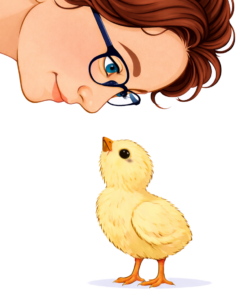
Two tiny fluffy yellow chicks.
At this point, you have to fill in for mama. That means teaching them to eat and drink.
Peachicks are notorious for not knowing instinctively how — or what — to eat. I added some water to the chick starter to make it mush, put a drop of water on my finger, and prayed.
If I could get one to do it, the other would follow.
At first, they weren’t interested.
Then one took the drop of water on a closed beak.
It dribbles into the crack.
Swallow.
Pay dirt.
I tapped the mash.
No dice.
They can go 48 hours without food after hatching. I was on hour four.
Plenty of time to panic later.
The One Who Always Came to My Voice
They were darling, though.
They would run in and out from under the brooder plate — a warming device I had surrounded with feathers to simulate “mom.”
Mom was a heat lamp and some craft supplies.
One of them always came out to my voice.
That was Chick 2.
Almost identical to Chick 1, except for demeanor. I could always tell them apart instantly. Chick 1 was cautious. Chick 2 had opinions.
I tried so hard to leave them alone. I did not want them to imprint on me.
I had read horror stories of “bathtub chicks.”
These are the birds raised by well-meaning novices who do no research. They start the chicks in a bathtub instead of a proper brooder. They let them follow them around the house — where they can get stepped on, lost, or worse. They cuddle them constantly. They set no boundaries.
Then, months later, they put this fully bonded bird outside in a pen.
And they wonder why it screams.
And bites.
And holds a grudge for the next thirty years.
A bathtub chick doesn’t just cry for attention. It grows into a large bird with resentment issues and a long memory.
There was no way that was going to fly here.
I was adorable.
The Day the Battle Began
The day after they hatched, Chick 2 started to whistle when I left the room.
Oh no.
I tried to distance myself. Dimming the room for nap time seemed to work.
Then, in the middle of a teleconference, Chick 2 started to whistle.
Loudly.
Not a tiny chick whistle.
A “you can hear it in the other room” whistle.
A “your clients are now aware you have livestock” whistle.
Three ounces of bird. All of it lungs.
And it didn’t stop.
I ignored it as long as I could. Then I finally said, “Hold on,” walked with my laptop into the guest room, and sat on the floor.
The chick saw me.
Silence.
Immediate silence.
Like a toddler who was fully prepared to scream until someone showed up, and now that someone had shown up, everything was fine and always had been.
I showed my teleconference attendee my “predicament” — which got the expected ohs and ahhs.
And I sat on that floor for the next hour.
Because apparently I work for a bird now.
At the time, I didn’t know if I was winning or losing. I didn’t know if this chick was a boy or a girl — and males have it worse with imprinting. I didn’t know if the boundaries I was trying to set would hold.
All I knew was that this was going to be an uphill battle.
Spoiler: it was.
The Realization
I noticed this little one didn’t have object permanence yet after waking up. If I wasn’t visible, I didn’t exist. And if I didn’t exist, that was cause for alarm.
So I dashed out and decided they needed more space. Distance. Boundaries.
You know. The things that work on birds.
That little chick — who was later named Morpheus because of its lung capacity — kept this up every time it saw me, right up until it fell asleep.
At one week, I moved them out to the porch.
From then on, I was summoned every day.
Maybe once.
Maybe.
For months, it was an uphill climb. Boundaries tested. Whistles ignored. Guilt suppressed.
But that’s a story for later.
If you need me, I’ll be realizing there is no spoon, there is no schedule, there is only Morpheus and googling “how to explain to a bird that I have other responsibilities.”