
The Origin Story
The Structure That Was Definitely Not a Coop

Here’s the thing about peachicks: they grow.
I know that sounds obvious. All baby animals grow. But peachicks grow in a way that suggests they are personally offended by the size of their enclosure and are determined to make it feel inadequate as fast as possible.
Han and Leia had started in the red brooder on the porch. Cozy. Manageable. A sensible amount of bird in a sensible amount of space.
Then they got bigger.
Then they got bigger fast.
By the time I was incubating the eggs that would become Morpheus and Neo, I’d already had to build the older two a rabbit hutch — eight feet long with a four-foot run attached — just to give them room to stretch, flap, and pace without turning the brooder into a demolition derby.
The upgrade worked. For a while.
But now I had four chicks on the porch, two age groups, and Han and Leia were putting on size like they’d made it a personal goal. The rabbit hutch that had felt generous two weeks ago was starting to feel like a studio apartment for birds who had discovered they had opinions about square footage.
Meanwhile, Morpheus and Neo were outgrowing the red brooder at a pace that suggested they had read ahead in the manual and were skipping chapters.
It was becoming very clear, very quickly, that the next step needed to happen soon.
Probably yesterday.
The Housing Crisis (A Progression Nobody Planned)
I had not set out to build three enclosures.
The red brooder was supposed to be it. One brooder. Simple.
Then Han and Leia needed more room, so I built the rabbit hutch.
Then Morpheus and Neo hatched and inherited the red brooder, which meant I now had two enclosures on a porch that was never designed to be an aviary.
Now the older birds needed to move outside. They needed real quarters — space to grow for the next six to nine months while they matured. Something with room. Something secure. Something that could handle birds who were getting big enough that the rabbit hutch was starting to look like a suggestion rather than a boundary.
Every enclosure I’d built had been a response to the same realization: birds grow faster than plans.
I was chasing a moving target with lumber and screen.
I needed a plan.
Of course I did.
The Constraint That Shaped Everything
There was one rule I could not break.
I had promised James: no coop.
The whole peacock pitch — the 37-point plan, the careful presentation, the “this is your one chance” moment — had been built on a foundation of “they roost in trees” and “they free range” and “you will not have to clean anything.”
A coop would have been an admission that this was, in fact, poultry ownership with infrastructure.
A coop would have meant James was right.
A coop was not an option.
So I started looking up plans online. Walk-in coops. Predator-proof enclosures. Large bird shelters.
And that’s when I noticed something interesting.
Every single “walk-in coop” plan I found was essentially a greenhouse with screen on it.
A greenhouse.
I love to garden. I had been wanting a greenhouse for years. And here, staring back at me from the internet, was a structure that was clearly, obviously, and undeniably a greenhouse.
It could just also house birds with some modifications.
The logic was airtight.
The Pitch (Such As It Was)
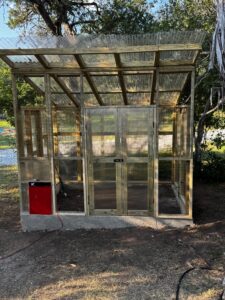
I proposed it to James as: “Hey, can I build a greenhouse that can temporarily be used for the birds?”
I didn’t get an objection.
I took that as permission and moved on.
I designed it myself.
Side entry doors. Wide front doors. Tall enough to walk in comfortably. Wide enough on the sides to eventually store the family mower.
It was a gardening structure. It would house the birds for the interim — six to nine months, maybe a year — and then transition into a proper greenhouse for me.
A greenhouse that could have tree-limb perches.
And heaters.
And eventually, cameras.
Details.
I hired two of the guys who had worked on previous outside projects with me, and construction began. We built it with a twenty-five-by-fifteen-foot pen attached, giving Han and Leia the kind of square footage that peafowl actually need.
Definitely a Greenhouse
The structure went up quickly.
It had screen walls. A solid roof. Doors that latched. A pen where the birds could spend their days with room to run, flap, and do whatever teenage peafowl do when they think no one is watching.
It was everything Han and Leia needed for the next chapter.
And it was absolutely, unequivocally, without question, a greenhouse.
If it looked like a coop, functioned like a coop, and housed birds like a coop — well, that was just a coincidence that nobody in this household needed to discuss.
If you need me, I’ll be adjusting the perches in my “greenhouse” and googling “at what point does a gardening structure become a coop and is there a legal precedent.”