Peafowl Care & Resources
field notes from someone who learned the hard way
People ask me all the time: “What’s it actually like raising peacocks?”
The honest answer is that it’s equal parts research, improvisation, and accepting that the birds have read none of the same books you have.
This section is where I share what I’ve learned — the practical stuff, the hard-won stuff, and the stuff I wish someone had told me before I ordered seven eggs on eBay.
I’m not a vet. I’m not a breeder. I’m someone who started with three peachicks, broken ribs, and a 37-point plan that lasted about a week. Everything here comes from experience, research, and the kind of learning that only happens when something goes wrong at 10pm and shipping is not an option.
Peafowl 101
There are three species of peafowl: Indian (the ones you’re picturing — blue and green with the famous train), Green (larger, more iridescent, significantly harder to keep), and Congo (smaller, African, rarely kept in captivity). Almost every backyard peafowl in the U.S. is Indian blue or a color mutation of it.
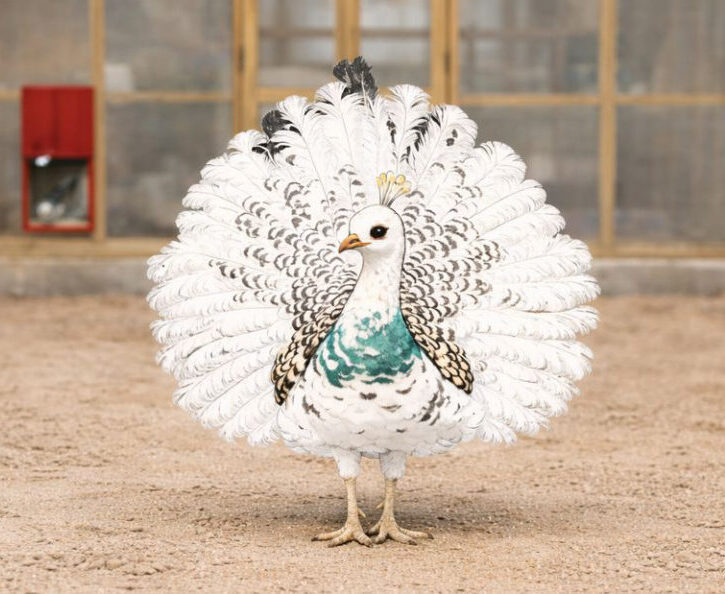
White peacocks are not albino — they’re leucistic. Albino birds would have pink eyes. Leucistic birds have a genetic color variation that removes pigment from the feathers but leaves the eyes dark. They’re striking, they breed true, and they cost more.
Size-wise, an adult male Indian peacock stands about 3.5–4 feet tall with a train that adds another 4–5 feet. They weigh 8–13 pounds. Peahens are smaller — about 3 feet, 6–9 pounds. These are not small birds. The first time one of mine stood on the porch railing and looked me in the eye, I realized I had fundamentally miscalculated the scale of this decision.
And yes, they can fly. Not long distances, but peafowl are strong short-burst fliers — enough to clear a 6-foot fence without touching it and roost 30 feet up in a tree. If you thought a fence would contain them, adjust your expectations. Farther than you think, and just far enough to get somewhere you didn’t plan for.
A group of peafowl is technically called an “ostentation.” Which, if you’ve ever watched a peacock walk across your driveway like he owns the mortgage, feels about right.
Peacock = male. Peahen = female. Peafowl = the species (like saying “deer” instead of “buck” or “doe”). Peachick = baby.
Most people say “peacock” to mean all of them, and nobody will correct you at a dinner party. I use the wrong word constantly. The birds don’t care. The internet does. But if you’re researching care, knowing the terms helps — especially because males and females have different needs, behaviors, and health considerations.
In captivity with good care, peafowl can live 20–30 years. Some have been reported to live even longer.
This is not a hobby phase. This is a multi-decade relationship with animals that will outlive most of your appliances and possibly your patience. Plan accordingly.
It’s courtship. The entire train exists to impress peahens, and the display is the sales pitch. The shaking — that full-body rattle where the feathers vibrate — is the closing argument.
When a peacock fans his train, he’s creating a shimmering wall of iridescent eyespots. Then he shakes — that rapid vibration you see creates a rattling sound and makes the eyespots appear to float. Studies have shown that peahens pay attention to the number, size, and symmetry of the eyespots. The males know this. The effort they put in is frankly absurd.
The “dancing in the rain” thing is timing, not joy. Monsoon season in South Asia — where peafowl are native — coincides with breeding season. Rain signals the start of mating, so the birds display more actively when it rains. They’re not celebrating the weather. They’re flirting. So no, your peacock is not dancing for joy in the rain. He’s just heard the dinner bell for mating season, and he does not care that you’re standing in your bathrobe watching.
Peahens, for the record, do not have the train. They have shorter, brown-and-green plumage designed for camouflage — because someone has to sit on the nest without attracting every predator in the county. The flashy one gets the attention. The practical one does the actual work. The peahens don’t need the flash. They’re the ones doing the choosing. It’s a system I respect. Draw your own metaphors.
Every year. Males shed their entire train after breeding season — usually late summer or early fall. One day you have a magnificent bird; the next day your yard looks like a craft store exploded.
The molt takes a few weeks. The train grows back over the following months, reaching full length again by the next breeding season. It’s a complete annual cycle: grow, display, shed, repeat. During the molt, your glamorous peacock will look like he lost a fight with a leaf blower. This is normal. He will also act like nothing happened.
Young males don’t grow a full train until they’re about two to three years old. At one year, they’ll have some longer feathers but nothing like the full fan. By year three, you’ll have the full spectacle — and the full attitude that comes with it.
The shed feathers are genuinely beautiful, and you will find them everywhere. Stuck in the screen door. Wedged under the truck. Delivered to your porch like unsolicited gifts. People collect them. Your birds will provide whether you asked or not.
They can be. It depends on the bird, the situation, and whether you made the mistake of imprinting a male on yourself. (Don’t imprint a male on yourself.)
During mating season, males get territorial. They will posture, charge, and occasionally spur. Most of the time it’s bluff — they’re large and loud but not typically dangerous to adults. Kids and small pets are a different story.
Peafowl also have a reputation as farm guardians, and there’s some truth to it — they have loud alarm calls and will alert you to anything unusual. They’ve been known to chase off snakes, rodents, and small predators. But they’re not guard dogs. They’re an alarm system with opinions. Don’t count on them to protect your chickens from a coyote — they’ll announce the coyote and then leave.
Yes. In two ways, and they’re both annoying.
First, they’ll perch on it. Roof, hood, trunk — any flat surface works. They’re heavy birds with strong feet, and they don’t care about your paint. Scratches, dents from landing, and droppings are all part of the deal.
Second, they’ll see their reflection in doors and bumpers and interpret it as a rival. Then they’ll peck at it. Repeatedly. With enthusiasm. Your paint job will not thank you.
This is not hypothetical. This is my driveway.
If you have vehicles you care about, park them in a garage or invest in car covers. There is no training this out of them. You’re not going to win an argument with a bird who thinks your vehicle is a rival he needs to keep in line.
Before You Commit
That depends on your definition of “pet.”
They are not dogs. They will not come when called — unless you have mealworms, and even then it’s a negotiation. They do not cuddle. They do not fetch. They will, however, follow you around the yard, scream at your delivery drivers, and develop strong opinions about your car.
Peafowl can be wonderful to raise and live with. But they are semi-wild birds with big personalities and very specific needs. If you’re looking for a hands-off, low-maintenance animal, this is not it. If you’re looking for something that will keep you humble and constantly entertained, you’ve found your bird.
More than you think.
The general guideline is roughly 80–100 square feet per bird for an enclosed pen or run. If they’re free ranging, they’ll use as much space as you’ll give them — peafowl can roam several acres in a day.
They need room to run, flap, and eventually display (males need space for that tail). Cramped birds get stressed, and stressed birds get aggressive or sick. If you’re planning to keep them in an enclosure full-time, plan big. If you’re planning to free range, you still need a secure shelter for nighttime.
Technically, maybe. Practically, probably not.
The noise alone will be an issue. Peacocks have a mating call that can be heard up to a mile away, and it is not a pleasant sound to people who did not choose this lifestyle. Many municipalities and HOAs have ordinances against keeping peafowl.
Before you buy a single bird, check your local zoning laws, HOA rules, and have an honest conversation with your neighbors. Peafowl are better suited to rural or semi-rural properties with some acreage.
Loud.
The adult male mating call is the famous one — a sharp, repeated “HELP! HELP!” sound that carries across properties. This happens primarily during breeding season (spring and summer), but some males vocalize year-round.
What people don’t warn you about is chick noise. Distressed peachicks can produce an impressive volume of whistling that goes on for extended periods, especially at dusk.
Outside of mating calls, peafowl also have alarm calls (honking), contact calls (softer sounds to locate each other), and general vocalizations throughout the day. They are not quiet animals.
Yes.
Peafowl are flock birds. A single peafowl will become stressed, lonely, and potentially aggressive. They need companions — ideally at least two, and preferably more.
A lone peacock is a problem waiting to happen. They can develop behavioral issues that don’t unwind easily. If you’re only planning on one bird, reconsider.
You have a few options, each with tradeoffs.
Local breeders: Best option if you can find a reputable one. You can see the birds, ask questions, and avoid shipping stress. Ask about flock health, medications, and whether chicks have been treated for coccidiosis.
Shipped chicks: Available from hatcheries and breeders who ship. The risk is transit stress — you open the box and hope for the best. Losses during shipping are not uncommon.
Hatching eggs: You can order fertile eggs and incubate them yourself. Expect roughly a 30% hatch rate on shipped eggs — experienced keepers on the BYC forum report anywhere from 0% to 40%, with many saying 10% is a good result.
Online marketplaces: eBay, Facebook groups, Craigslist. Quality varies wildly. Do your research on the seller.
Whatever route you choose, ask questions. A good breeder will answer them. A bad one won’t.
From the ranch
I spent two months researching before I bought a single bird. I took notes. I made spreadsheets. I felt prepared. What I didn't plan for: the mess, the expense, the noise at 8pm every night for three months, and the part where one of them imprinted on me despite my best efforts.
Eggs, Chicks & Brooding
Peahens typically lay 3–8 eggs per clutch, usually one every other day. They don’t start incubating until the clutch is complete, so the eggs hatch close together. Incubation takes 26–30 days — whether under the hen or in an incubator.
Not every peahen is a good sitter on nests. Some are dedicated; some abandon the nest halfway through because they heard a leaf drop. If you’re incubating artificially, you’ll need a reliable incubator, a hygrometer, and patience. Temperature and humidity matter more than you think.
Sexing peachicks is tricky for the first few months. Some people claim you can tell by leg thickness or feather patterns early on, but it’s unreliable. By about 4–6 months, males will start showing slightly different coloring on the wing bars and chest. By a year, it’s obvious. Before that, you’re guessing — and so is everyone selling you “guaranteed sexed” chicks.
Can you eat peafowl eggs? Technically, yes. They taste similar to chicken eggs, slightly richer. But a peahen only lays 15–30 eggs a year compared to a chicken’s 250+, so it’s not exactly a production operation. By the time a peahen is old enough to lay, you’ve got about $300 invested in her — and she’ll take eight months off between laying seasons. Hatching eggs sell for $25–35 each with no guarantee they’re even fertile. So you can absolutely make yourself an omelet. Just know what you’re eating.
At minimum: a brooder enclosure (large plastic tub, stock tank, or purpose-built box — draft-free, easy to clean, large enough that chicks can move away from heat), a heat source (brooder plate preferred over heat lamps for fire safety), bedding (paper towels first week, then non-cedar shavings), high-protein feed, a shallow waterer with marbles or pebbles (peachicks can drown in surprisingly little water), a mirror (seriously — mirrors create a “virtual flock” and dramatically reduce stress pecking), and a thermometer.
Start at 95–100°F directly under the heat source for the first week. Reduce by approximately 5 degrees per week until they’re feathered out and acclimated to ambient temperature, usually around 6–8 weeks.
You will check the thermometer seventeen times the first night. This is normal.
The best indicator isn’t the thermometer — it’s the chicks. If they’re huddled directly under the heat, they’re cold. If they’re as far from it as possible, they’re hot. If they’re spread out comfortably, you’ve got it right.
For the first day or two, you may need to teach them to eat. Peachicks are not born knowing what food is. Tapping the feed with your finger, adding a small amount of water to make it mushy, and placing a drop of water on their beaks can help get them started.
After a few weeks, you can begin introducing treats — small mealworms, finely chopped greens, and eventually a wider range of foods.
For starter feed, you’re looking at the same chick starter you’d use for chickens. You’ll hear a lot about high-protein feed for peachicks, and that matters — but it doesn’t need to kick in immediately. Standard chicken starter in the 18–20% protein range works for the early weeks.
I went with Nutrena NatureSmart Organic Chick Starter Grower — 20% protein crumble. Non-medicated, which was a deliberate choice after a lot of conversations and a lot of reading. I medicated separately with toltrazuril (the same one listed in the first aid section). I’m not getting into the medicated-vs-non-medicated debate here — that’s a rabbit hole best explored on the BYC forums with people who have strong opinions and the experience to back them up. This is just what I did.
Generally around 3–4 months, depending on the weather and whether they’re fully feathered.
They need to be completely off supplemental heat and have a full set of juvenile feathers before transitioning outside. The enclosure they move into should be predator-proof — peachicks at this age are still small enough to be vulnerable to hawks, raccoons, snakes, and cats.
Don’t rush this. The first four months are the highest-risk window. Their immune systems aren’t fully developed, and exposure to wet, cold, or contaminated ground too early can be fatal.
I kept mine inside longer than most guides recommend. The guides weren’t the ones pacing at 2 a.m. checking the weather app.
You probably can’t prevent it entirely — but you can manage it.
Limit unnecessary handling. Don’t let them follow you around the house. Cover brooder windows when you’re not actively caring for them. Provide mirrors and companions so they bond with each other, not you.
If a chick does imprint, the key is firm, consistent boundaries. It will call for you. It will be loud about it. You will feel terrible. Hold the line anyway.
A critical warning from experienced keepers: if you’re going to imprint a bird, make it a hen. Imprinted male peacocks can become aggressive during breeding season — territorial, possessive, and potentially dangerous to people. There’s a real difference between “tame” (eats from your hand, tolerates you) and “imprinted” (thinks you are its flock). When a male hits maturity and decides you’re a rival in his territory, it’s not cute anymore.
Imprinted hens can be bossy with other birds but are generally not a danger to people. Males are a gamble. The problem is you can’t reliably sex peachicks until they’re several months old — well past when imprinting happens. So by the time you realize you’ve got a male, the damage is done. The safest approach is to avoid imprinting altogether.
Don’t panic immediately. (You will panic. That’s fine. Panic quietly and keep reading.) Peachicks can survive 24–48 hours after hatching without food — they absorb the yolk sac, which sustains them.
Try these in order: tap the food with your finger (mimics a mother hen pecking), add water to the crumble to make a mush, place a drop of water on the tip of their beak (it dribbles in and they’ll swallow), try a hard-boiled egg yolk crumbled fine.
If a chick hasn’t eaten anything in 48 hours and is lethargic, you may need to intervene with electrolyte water (like Sav-A-Chick) via dropper. If it continues beyond that, consult an avian vet or experienced breeder.
Lower than you want to hear.
Getting peachicks from shipped eggs to maturity involves compounding odds. Shipped eggs have roughly a 30% hatch rate. Of those that hatch, the first four months are the highest-risk window — coccidiosis, failure to thrive, environmental hazards, and predators account for most losses. Buying older chicks (1–3 months) improves the odds.
After four months, their immune systems are more developed and survival rates improve significantly.
This is not meant to discourage you — it’s meant to prepare you. If you go in expecting losses and preparing for them, you’ll handle them better than if you assume every chick will make it.
Diet & Feeding
Peafowl are omnivores. In the wild and when free ranging, they eat insects, small reptiles, seeds, berries, plants, and basically anything they can find and fit in their beak.
In captivity, the base diet should be a quality feed appropriate to their age and stage. Supplement with treats, greens, and whatever they forage when free ranging.
Adults are less fragile about diet than chicks, but the base feed still matters — especially for hens during laying season and for growing juveniles.
At around 14 weeks, I started transitioning my chicks to their adult feed. After a frankly unreasonable amount of research, I went with Don Roberto La Cuida — 22% Protein Gamebird & Poultry Grain Feed. It’s a relatively unknown brand, but I liked what was in it. Fair warning: it’s expensive, and not everyone will agree with me. That’s fine.
My second choice would be Kalmbach Feeds All Natural 20% Protein Full Plume Feathering Chicken Feed — solid option, more widely available.
What you pick depends on your setup. Free-ranging birds burn more energy and need more protein. In winter, they need more carbs to maintain body heat. My birds prefer pellets over crumble, which I discovered after they looked at the crumble like I’d personally insulted them.
These are my choices, not gospel. Talk to other keepers. Read the BYC forums. Find what works for your birds and your budget.
Avocado — toxic to birds. Chocolate — toxic. Raw dried beans — toxic. Anything moldy — can cause aspergillosis, a serious fungal infection. Excess salt, processed foods, sugary foods. Onions and garlic in large amounts.
When in doubt, don’t feed it. Peafowl will eat things they shouldn’t — that’s what they do. Your job is to control what’s available.
Yes.
Free ranging supplements their diet — it doesn’t replace it. They’ll find bugs, seeds, and plants, but they still need consistent access to feed, especially in winter when forage is limited.
Think of free ranging as the salad bar. The feed is the main course.
Mealworms (live or dried) — the universal peafowl currency. If you need a bird to do anything, mealworms are your leverage. Chopped fruits (grapes halved, berries, watermelon, banana). Chopped vegetables (leafy greens, peas, corn). Cooked eggs — scrambled or hard-boiled. Crickets and other live insects.
Keep treats to roughly 10% of their overall diet. The base feed does the nutritional heavy lifting.
Yes to both.
Peafowl are enthusiastic insect hunters, and ticks are on the menu. They’ll also eat mosquitoes, grasshoppers, beetles, and anything else small enough to catch. Some people keep peafowl specifically for pest control, and they do make a dent — but they’re not going to eliminate your tick population. Think of them as part of the strategy, not the whole strategy.
Snakes are a different story. Peafowl will kill and eat small snakes, and they have a reputation for keeping snake populations down around a property. Whether this is meaningful pest control or just an entertaining bonus depends on your snake situation. Ours have gone after everything from garden snakes to things I’d rather not have seen up close.
They are not immune to snake venom. A venomous bite can kill a peafowl. The birds don’t know the difference between a rat snake and a copperhead, and they’ll go after both with the same confidence. This is one of those situations where the bird’s bravery outpaces its judgment.
Housing & Enclosures
They need shelter. Whether you call it a coop is between you and your spouse.
Peafowl need a secure, enclosed space for nighttime roosting — protected from predators, wind, and extreme weather. During the day, they can free range or use a pen, but at night they need somewhere safe.
This can be a converted shed, a purpose-built structure, or — hypothetically — a greenhouse that was definitely not designed as a coop but happens to function as one.
Something that keeps them alive at night and doesn’t make you cry when you look at the credit card statement.
The shelter should be: predator-proof (latching doors, no gaps larger than an inch, protection from digging predators), ventilated but draft-free (good airflow prevents respiratory issues but direct wind on roosting birds is a problem), tall enough for perches (at least 4–5 feet off the ground, with ceiling height to accommodate them standing on perches), large enough (80–100 square feet per bird in enclosed space), and easy to clean.
Every shortcut you take is something a raccoon will find at 3 a.m.
Use hardware cloth, not chicken wire. Chicken wire keeps chickens in — it does not keep predators out. Raccoons can reach through it. Determined predators can tear it.
Bury hardware cloth 12–18 inches into the ground around the perimeter, or lay it flat in an apron extending outward to deter digging predators.
Secure all doors with latches that require two motions to open. Raccoons can operate simple latches.
Cover the top. Hawks and owls are real threats, especially to younger birds.
Inspect regularly. A fence that was secure last month may have a new gap this month.
Build it like something is actively trying to get in. Because something is.
They can, and many do. But it comes with risk.
Full free-range birds are exposed to predators during the day (hawks, coyotes, dogs, foxes) and at night if they roost in trees instead of a shelter.
The compromise that works for many keepers is semi-free range: birds have access to a secure shelter at night and free range during the day. Training them to come back to the shelter at dusk takes patience but is doable.
Yes. Peafowl roost — it’s instinct. They want to be up high.
Perches should be natural tree limbs or branches (2–4 inches in diameter) mounted at least 4–5 feet off the ground. Avoid dowels or smooth poles — their feet need texture to grip.
Space perches far enough apart that birds aren’t crowded. Crowded perches lead to pecking, bullying, and the kind of nighttime drama that you will end up watching on security cameras at midnight.
Indian peafowl are hardier than they look. They can handle temperatures well below freezing, and they’re kept successfully across the northern U.S. and Canada.
What they cannot handle is prolonged wet cold, drafts, and frostbite. Their feet and the fleshy parts of their face are vulnerable in extreme cold. The shelter matters more than the temperature — a dry, draft-free, well-ventilated structure with deep bedding and high perches will get them through a hard winter.
They’ll also need unfrozen water daily and may eat more in winter to maintain body heat. Some keepers add a flat-panel radiant heater for the worst nights, but most healthy adult peafowl don’t need supplemental heat if the shelter is solid.
The birds you should worry about in cold weather are the young ones — anything under six months. They don’t have the body mass or the feather coverage to regulate temperature well yet. Plan accordingly — and budget for the electricity bill, because you will run a heater for them whether they need it or not.
Health & First Aid
Coccidiosis is the big one. It’s a parasitic infection that targets the gut, and it kills peachicks fast. Symptoms include lethargy, loss of appetite, puffed-up appearance, and bloody or abnormal droppings.
Beyond that: respiratory infections, leg and foot issues (especially splayed leg in very young chicks), crop impaction from swallowing things they shouldn’t, and general failure to thrive — which is the catch-all for chicks that just stop progressing and fade.
The pattern you’ll notice is that peachicks don’t give you a long warning. By the time you see obvious symptoms, you may already be behind. That’s why prevention and observation matter more than treatment.
Coccidiosis is caused by coccidia — microscopic parasites that live in the soil and in droppings. Nearly every environment has them. The issue isn’t exposure — it’s overwhelming exposure before the chick’s immune system can handle it.
Prevention includes medicated feed (some starters contain amprolium), toltrazuril given preventatively on a schedule, and clean brooder management — regular bedding changes, keeping waterers clean, not letting droppings accumulate.
The goal isn’t a sterile environment. It’s controlled exposure so their immune systems develop without being overwhelmed.
I went with non-medicated starter feed and administered toltrazuril separately on a preventative schedule. Dosing protocols vary and people have strong opinions — I’m not going to pretend mine is the only way. Check the BYC forums for current dosing discussions and talk to experienced keepers before you commit to a protocol.
<!– replaced — check back for updates.]
At minimum: Blue-Kote (gentian violet antiseptic — for wound care and discouraging picking), electrolyte supplement (like Sav-A-Chick), syringes and droppers, styptic powder or cornstarch (for bleeding), Vetericyn wound spray, tweezers, and a scale for tracking weight.
You won’t need all of this on day one. But by the time you need it, you won’t have time to order it.
check back for updates on this list
In order: Is it eating and drinking? (Loss of appetite is the first watch — weigh the bird if you can.) Check the droppings for abnormal color, consistency, or blood. Check for visible injuries — picking wounds, leg issues, eye problems.
This is the part of keeping peafowl that nobody romanticizes. You’re not posting this to Instagram. You’re standing in a pen at 10 p.m. trying to figure out if your bird is sick.
Is it puffed up and sitting with its eyes closed? This is a bird telling you it doesn’t feel well. In peafowl, by the time they look visibly sick, the situation may already be advanced.
Isolate the bird from the flock, provide warmth and electrolyte water, and assess whether you need veterinary intervention. Don’t wait to see if it improves overnight — with peafowl, overnight can be too late.
Important: If your bird is sick, go to the Peafowl Forum on BackYard Chickens and post. Include photos, symptoms, age, and what you’ve already tried. That community has seen everything. This is what I would be doing.
Maybe, but don’t count on it.
Most small-animal vets have limited experience with poultry, let alone peafowl. An avian vet is your best bet, but they can be hard to find and expensive.
Most day-to-day peafowl health management falls on you. Building a first aid kit, learning to recognize symptoms, and connecting with experienced keepers online will serve you better than assuming a vet can handle it.
That said, for emergencies — severe injuries, suspected poisoning, conditions you can’t identify — having a vet relationship is important. Call ahead and ask if they see poultry or game birds before you need them urgently.
I’m putting together a detailed list of what’s actually in my medication box and what each one is for. Check back.
<check back for updates.>
A note from the BYC community: Experienced keepers are emphatic that so-called “natural” remedies — apple cider vinegar, garlic, diatomaceous earth, yogurt — do not work for treating peafowl illness and some are actively harmful. Deworm your birds on a schedule with proper medication. This is one area where anecdotal “natural” advice from the internet can cost you a bird.
Timeline note
Order your first aid supplies before your birds arrive. Shipping takes days. Peafowl health emergencies take hours. By the time you need something, you won't have time to order it.
Behavior & Socialization
Yes, but carefully. And by “carefully” I mean “with the vigilance of a middle school hall monitor.”
Age gaps matter more than you’d think. My birds are only eleven weeks apart, and the older pair established dominance immediately. Mixing age groups requires supervised introductions, visual barriers (so they can see each other without making contact), and patience.
The younger birds need to be big enough to hold their own before full integration. Rushing this leads to bullying, stress, and birds who would rather sleep on a roof in the cold than share a perch with their tormentors.
Pecking order. It’s normal, and it’s relentless.
Peafowl establish hierarchy through posturing, chasing, pecking, and general intimidation. This is especially intense when mixing age groups, introducing new birds, or during hormonal changes.
Some fighting is expected and will settle over time. What you’re watching for is sustained bullying — one bird being targeted repeatedly, losing weight, unable to eat or roost in peace. That’s when you need to intervene with separation or barriers.
Welcome to the club.
Peafowl have strong roosting instincts, but they also have strong opinions about where they roost. If they’ve decided the roof is better than the shelter you built for them, you have a negotiation on your hands.
What I’ve learned: don’t disturb them at dusk. Your presence, your voice, your movement — all of it disrupts their instinct to settle. The most effective strategy I’ve found is to stand nearby, say absolutely nothing, and let them make their own decision.
If they need to be redirected, a long stick held low works better than your arms. You are a large, alarming creature. A stick is guidance.
And if it’s already dark? They’re not moving. Accept it. Try again tomorrow.
It depends on the birds, but proceed with caution. Peafowl have the energy of a species that didn’t evolve to compromise.
Peafowl can carry and transmit blackhead disease (histomoniasis), which is often fatal to turkeys. If you keep both, talk to a vet about prevention.
Peafowl and chickens can coexist, but peafowl are significantly larger and can injure chickens if disputes arise. They also have different dietary needs.
In general, peafowl do best with other peafowl. They tolerate other species. They do not necessarily enjoy them.
Several possible reasons: separation anxiety (a bird imprinted or separated from its flock will call loudly), alarm (something spooked them — check for predators or unfamiliar sounds), settling in (young birds are vocal at dusk as they figure out roosting arrangements — this usually decreases as routines establish), or just because — peafowl vocalize, and some birds are louder than others.
From the ranch
Our imprinted peachick required three months of nightly Andrea Bocelli to manage bedtime. Specifically, Sacred Arias. Specifically, "Ave Maria" and "Panis Angelicus." She had preferences. There is no scientific explanation for this.
Free Ranging & Predators
Most keepers recommend waiting until birds are at least 4–6 months old and have been in their shelter long enough to consider it home — usually at least 4–6 weeks in the enclosure before allowing free range access.
The shelter needs to be their anchor point. If you let them out before they’ve imprinted on it as “home,” they may not come back.
Start with supervised free range — short periods during the day with the shelter door open so they can return. Gradually extend the time.
Usually, yes — if you’ve done the groundwork.
Birds that have been in their shelter long enough to consider it home will typically return at dusk to roost. Feeding them in or near the shelter reinforces this.
That said, peafowl can and do wander. They may explore neighboring properties. They may decide a tree half an acre away is a better roosting spot. Training them to come to a call or treat sound helps, but it’s not foolproof.
If a bird doesn’t come back one evening, don’t panic immediately. Check trees. Check rooftops. Check anywhere high.
In Central Texas, the list includes: coyotes, foxes, raccoons, hawks, owls, bobcats, snakes, and loose dogs. Your area will have its own version of this list.
Daytime threats: hawks (especially for young birds), coyotes, foxes, dogs. Nighttime threats: raccoons (they climb trees and can knock roosting birds off perches), owls, coyotes.
Adult peafowl are large enough to deter some predators, and they have excellent alarm calls. A group of peafowl can chase off a fox. They cannot chase off a coyote pack.
The best protection is a secure shelter at night and vigilance during the day.
Mealworms and repetition.
Pick a specific sound — a whistle, a call, a shake of the treat container. Use the same sound every single time you offer treats. Do this consistently for weeks.
Eventually, the sound means food, and they’ll come. Not because they love you. Because they love mealworms.
This is not obedience. This is bribery. Accept it.
Ideally, yes — especially in areas with nocturnal predators.
Adult peafowl can roost in trees and many do survive this way. But tree roosting carries risk: raccoons climb, owls hunt at night, and severe weather can be dangerous.
If you can get them into a secure shelter at night, do it. If they refuse and insist on tree roosting, make sure the trees are tall, the branches are high, and you’ve done what you can to deter climbing predators.
Some birds will always prefer the tree. You learn to make peace with that — or you learn to stand outside in the dark with a stick and a lot of patience.
Still have questions?
Drop them in the comments below, or find me on Instagram. I may not have answers, but I definitely have opinions.